
Building the app is the easy part. Roughly one in four apps is opened once and never again, and most of those deaths are decided before launch — in feature bloat, a slow first-run experience and an onboarding flow that asks for everything before giving anything. We build Android and iOS apps around retention, not just a feature list.
Tell us what you need. You’ll hear back within one working day.
100% confidential. We sign an NDA on request.
Most app quotes cover development and stop there. Then the real bills arrive: Apple’s developer account renews yearly, Google deprecates an API and your app stops accepting payments, a new Android version breaks the camera permission, the signing certificate expires and nobody has the keystore. None of that is unusual. All of it is budgeted for when we scope a project, and quietly ignored by the cheapest quote on your desk.
The second thing we insist on is cutting the first release down. Founders arrive with forty features; we help rank them against what actually proves the idea, and ship a focused version 1.0 in a fraction of the time and cost. Every feature you postpone is one you don’t pay to build, test, maintain and eventually remove when nobody uses it. The roadmap keeps the rest — it just doesn’t block your launch.
Platform choice follows the same logic. Flutter or React Native gives you Android and iOS from one codebase at close to native quality, which suits most business and commerce apps. Native Kotlin or Swift earns its extra cost when you need heavy camera or AR work, background processing, Bluetooth hardware or platform-specific performance. And sometimes the honest answer is that you don’t need an app at all — a fast mobile site or a progressive web app will do the job without asking anyone to install anything.
Behind every app is the part users never see: APIs, database, authentication, push notification infrastructure, payment integration and an admin dashboard your team runs the business from. We build that properly, because an app is only as reliable as the backend answering it.
Have an app idea or an app that is not performing? Tell us about it and we will reply with a feature breakdown, a realistic cost band and a timeline.
Native Kotlin apps built for the devices your users actually own — including mid-range phones on patchy networks, older Android versions, and offline-first behaviour where connectivity cannot be assumed.
Swift and SwiftUI apps built to Apple's Human Interface Guidelines and its review rules, so the build does not stall in App Store review over privacy labels, sign-in requirements or payment policy.
One codebase for Android and iOS at close to native quality — the right call for most commerce, booking and service apps, and usually 30–40% cheaper than two separate builds.
REST APIs, database design, authentication and role management, push notification infrastructure, payment gateway integration, and a web dashboard your team uses to run orders, users and content.
Store listings, screenshots, privacy policy and data-safety declarations, app store optimisation for the keywords people search, and submission handled end to end — including the rejection replies when they come.
Crash reporting and analytics, OS version compatibility updates, SDK and dependency upgrades, certificate and keystore management, plus a monthly block of hours for new features.
Ordering apps for repeat customers — saved carts, reorder in two taps, loyalty points and push notifications that bring people back without paying for the click a second time.
Booking, scheduling and delivery apps with live tracking, slot management, customer and partner apps, and dispatch logic that matches how your operations really run.
Field force, dealer, inspection and inventory apps with offline data capture, photo and GPS proof, approval workflows, and sync the moment the device finds a signal.
A focused first release that proves the idea with real users, built so the code can be extended by whoever you hire next — not thrown away at your first funding round.
Not sure whether you need an app or a better mobile website? We will tell you honestly — including when the app is not worth building yet.
We map the user journeys, rank every feature against what version 1.0 must prove, and agree a scope, timeline and cost band. You leave this stage with a feature list and a roadmap, even if you build nothing with us.
Clickable prototype of the real screens, plus the decisions underneath — platform, API structure, database design, authentication and third-party services. Approved before code.
Two-week sprints with builds you install on your own phone throughout. Tested across a real device matrix, OS versions, screen sizes and poor-network conditions, not just an emulator.
Store listings, privacy and data-safety declarations, submission and review handling, then analytics and crash monitoring live from day one so the first-week drop-off gets fixed fast.
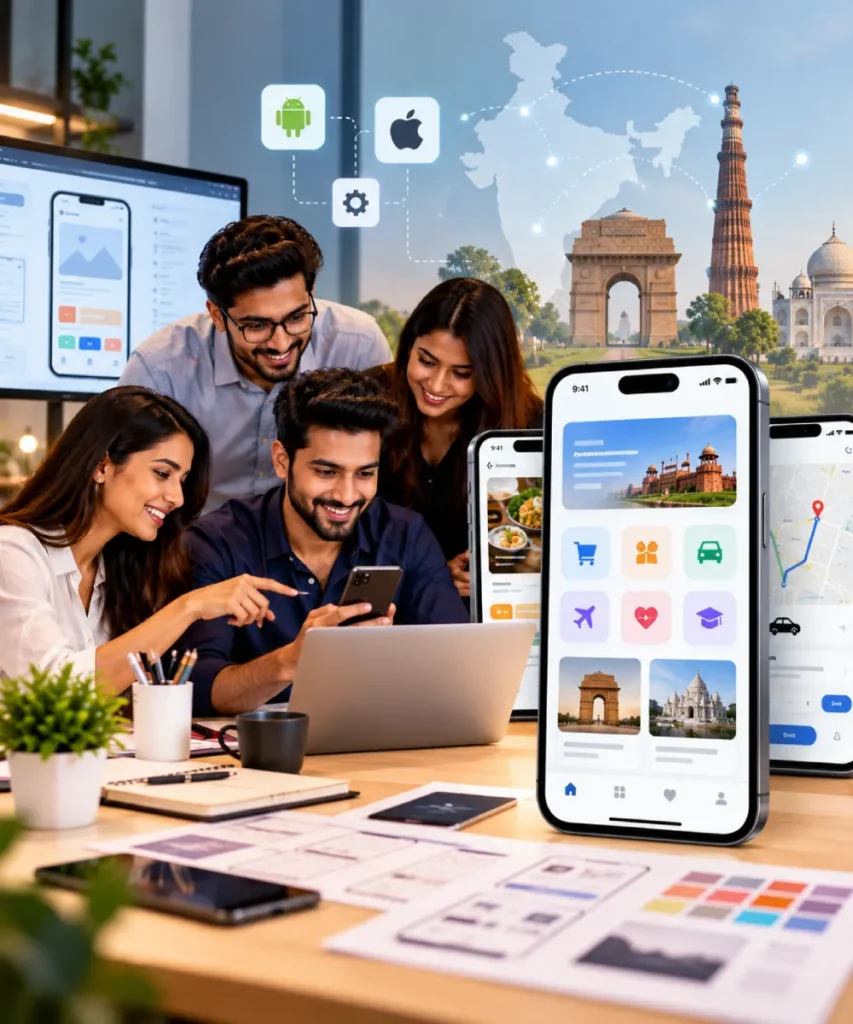
The calls we get sound the same every time. The app works, but it cannot be updated — the source code was never handed over, or it was, and nobody can build it. The Play Console and Apple Developer accounts are in the previous agency’s name, so the app the client paid for is legally not theirs. The signing keystore is lost, which means the existing app can never be updated again, only replaced with a new listing and zero reviews.
We avoid all of that by default. Your app is published under your own developer accounts from day one. Source code sits in your repository. The keystore and certificates are handed over with documentation on how to use them. Crash reporting and analytics are configured before launch so you find out about a problem from a dashboard, not a one-star review.
A focused MVP on Flutter or React Native, with a backend and admin panel, typically runs ₹3 lakh to ₹8 lakh. Marketplace, on-demand and enterprise apps with multiple user roles usually fall between ₹8 lakh and ₹25 lakh. Native Android and iOS built separately adds roughly 30–40%. We give a fixed scope and cost after the scoping session.
A well-scoped MVP takes 10–16 weeks including store submission. Larger apps with multiple roles, live tracking or complex integrations run 5–8 months, delivered in two-week sprints with installable builds throughout.
Flutter or React Native for most business, commerce and booking apps: one codebase, both platforms, lower cost, near-native feel. Native Kotlin or Swift when you need heavy camera or AR work, Bluetooth hardware, background processing or platform-specific performance.
If your users visit occasionally, a fast mobile site or progressive web app usually wins — nothing to install, nothing to update. An app earns its cost when you have repeat usage, need push notifications, offline capability or device hardware like GPS and the camera. We will say so if your case is the former.
You do, both. We publish under your own Play Console and Apple Developer accounts, hand over the source code, signing keystore and certificates, and document all of it. Losing a keystore means an app can never be updated again, so this matters more than it sounds.
We agree a minimum supported version at scoping based on who your users actually are, then test on a real device matrix, not just emulators — including mid-range phones and poor network conditions, where most real usage happens.
It happens, usually over privacy labels, data-safety declarations, sign-in requirements or payment policy. We build to those rules from the start and handle the review correspondence and resubmission as part of the project, at no extra cost.
Budget 15–20% of the build cost per year. That covers OS version compatibility, SDK and dependency updates, store policy changes, certificate renewals, crash fixes and monitoring. Thirty days of post-launch support is included with every project.
Tell us the idea, or send the app that is not performing. Within 48 hours you will get a written feature breakdown, a recommended platform, a realistic cost band and a timeline — plus an honest view on which features belong in version 1.0 and which can wait. Yours to keep whether you build with us or not.